How credits work
Skip-tracing one owner costs 1 credit. Credit packs are pay-as-you-go and never expire:
- 100 credits — $35
- 500 credits — $150
- 2,000 credits — $500
- 10,000 credits — $2,000
Credits live in your wallet (see /app/wallet). Any team member on Enterprise plans can pull from the shared wallet — we log who spent what for accountability.
Single trace vs batch
For a single property, the report has a Skip trace owner button. One click, one credit, results inline in 5-15 seconds.
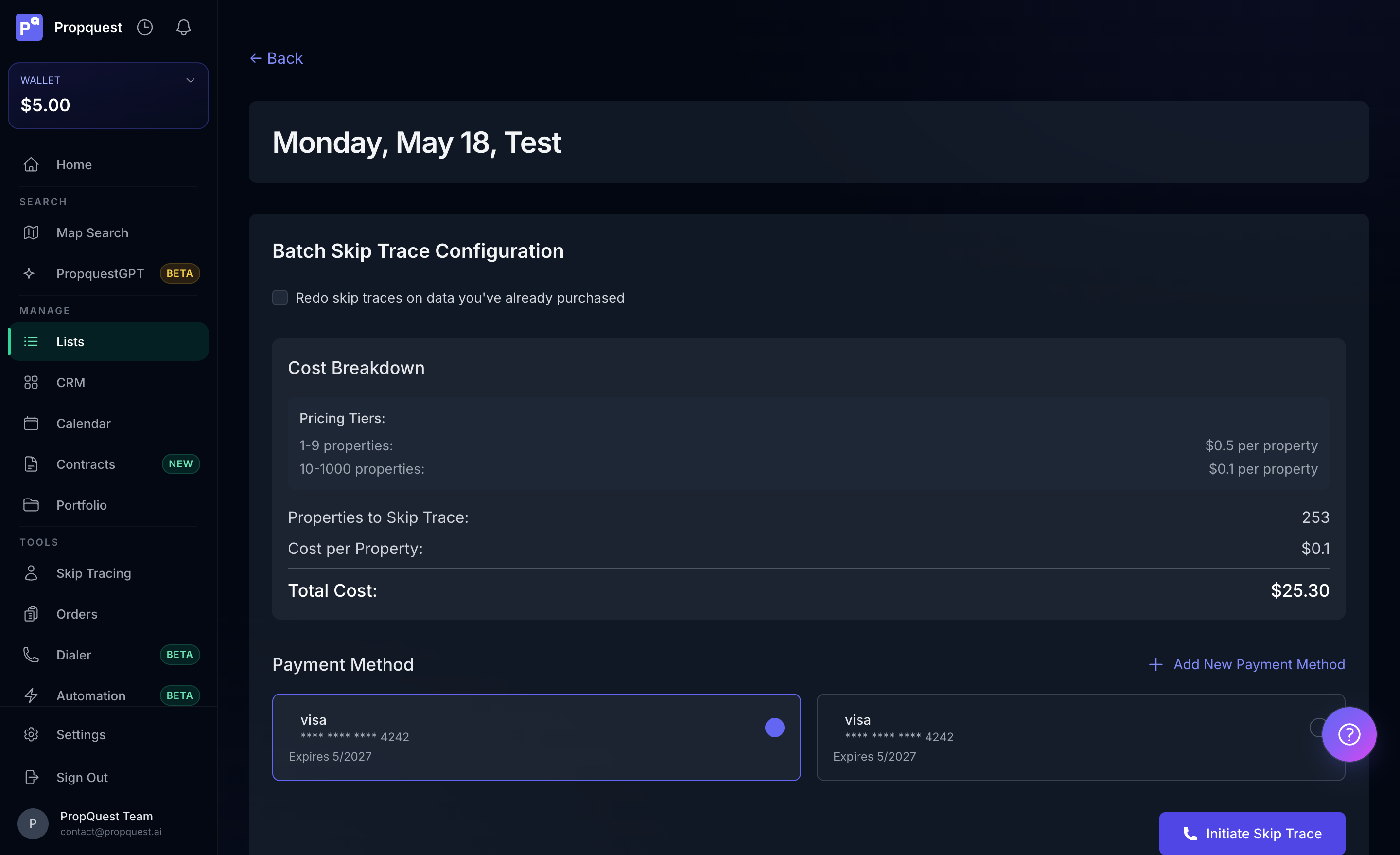
For lists, open the list and hit Bulk skip trace. You'll see:
- The credit cost (pre-flight, no surprises)
- A duplicate filter — we never charge twice for the same owner if you've already traced them in the last 90 days
- A confidence threshold — drop anyone below the threshold to avoid paying for low-quality matches
Batch limits
There's no hard cap, but very large batches (>2,000 owners) run in the background and email you when complete. You can keep working — the wallet only debits as results come back.
For batches over 10,000 we throttle the dispatch rate to avoid hammering the provider APIs and triggering rate limits that would slow you down. Expect ~1,500-2,000 results per hour at the top end.
What you get
Per owner, when available:
- Up to 5 phone numbers, ranked by recency
- Up to 3 email addresses
- DNC (Do Not Call) status per phone
- Litigator flag (skip these — they sue for TCPA)
- Deceased flag (route to probate workflow instead)
- Relatives + known associates (Pro+) — useful when the owner is hard to reach directly
Reading the confidence score
Every result carries a 0-100 confidence score. We compute it from how many providers agree on the match, recency of the data, and cross-reference against utility / voter / employment records where legally allowed.
Rules of thumb: 85+ is gold (dial first), 60-84 is workable (likely correct but verify identity before the pitch), under 60 is risky (you'll get "wrong number" half the time). Set the bulk-trace threshold to 60 if credits are tight, 0 if you want every possible hit and don't mind sorting.
When to retrace
Skip-trace data goes stale: phone numbers churn at ~2%/month, emails at ~1%/month. After 6-9 months a list traced once is materially less accurate than a fresh re-trace.
We surface a Last traced date on every contact. The 90-day dedupe window prevents accidental re-charges, but you can override it from Bulk skip trace → Force re-trace if a cold list isn't connecting and you suspect numbers have moved.
DNC, deceased, and litigator flags in detail
Three flags suppress phones automatically when you export Dialer-ready:
- DNC (Do Not Call) — the number is on the federal or state DNC registry. Legal to call only with prior express consent.
- Deceased — the SSN tied to the owner appears in the SSA death index. Their phone is somebody else's now; don't pitch the wrong person about an inherited property.
- Litigator — known to file TCPA / robocall lawsuits. Some make 5-figure income from suing investors. Skip every time, even if the number is technically callable.
These aren't suggestions — calling a DNC-listed number without consent carries $500-$1,500/violation statutory damages. Our suppression is opt-out, not opt-in, because the default should be safe.
Exporting
Three export formats from the list view:
- CSV — full data, drop into anything
- REISimple / BatchLeads schema — column names match so you can re-import
- Dialer-ready — phones only, DNC-suppressed, deceased-suppressed, deduped
We never sell or re-share your traced data. It's yours — and only yours.
Wallet billing and team accountability
Every trace logs the actor (which teammate triggered it), the property, the cost, and the result count. Open /app/wallet → Ledger to see the full history filterable by date, person, or list.
If a teammate burns through credits on a low-yield list, the ledger surfaces it within hours rather than at month-end. Enterprise plans can set per-user credit caps from Settings → Team → Credit limits to prevent any single account from draining the shared wallet.
Why dual-provider matters
We hit two providers in parallel and merge results. If provider A is down or returns sparse data on a specific market, provider B fills the gap.
You get the union of both for the price of one trace — that's how we hit 85%+ phone match rates where single-provider platforms hover at 60-65%. The merge logic dedupes overlapping phones, prefers the higher-recency source, and surfaces both DNC statuses when they disagree (we take the more conservative).